

Before country calling codes existed, placing an international telephone call required routing through multiple operators across different national networks, each using incompatible numbering systems. The history of country calling codes begins in earnest in 1960, when the international telecommunications community recognized that global telephone communication could not scale without a shared numbering framework. This article traces how those codes were created, expanded, formalized under ITU-T E.164, and shaped by a mix of engineering logic and geopolitical influence that still shows up in today's international dialing codes.
Table of Contents
- Key takeaways
- The history of country calling codes and their origins
- World numbering zones and global expansion
- The ITU-T E.164 standard and modern formalization
- Geopolitical examples in code assignments
- How country codes are assigned and managed today
- My perspective on what this history actually teaches
- Explore country codes with Countrycalling
- FAQ
Key takeaways
| Point | Details |
|---|---|
| CCITT started it in 1960 | Country codes were first defined by CCITT Recommendation E.29, covering Europe and parts of western Asia. |
| World zones organized global coverage | The 1964 expansion divided the world into nine numbering zones, giving each region a logical code prefix. |
| E.164 formalized the modern standard | ITU-T Recommendation E.164, published in 1988, set the 15-digit limit and hierarchical structure still in use today. |
| Politics shaped early allocations | Dominant nations like the US, UK, France, and USSR secured shorter, more convenient codes through geopolitical influence. |
| ITU governs ongoing assignments | Recommendation E.190 (2025) defines the current criteria for assigning, reclaiming, and reserving country codes. |
The history of country calling codes and their origins
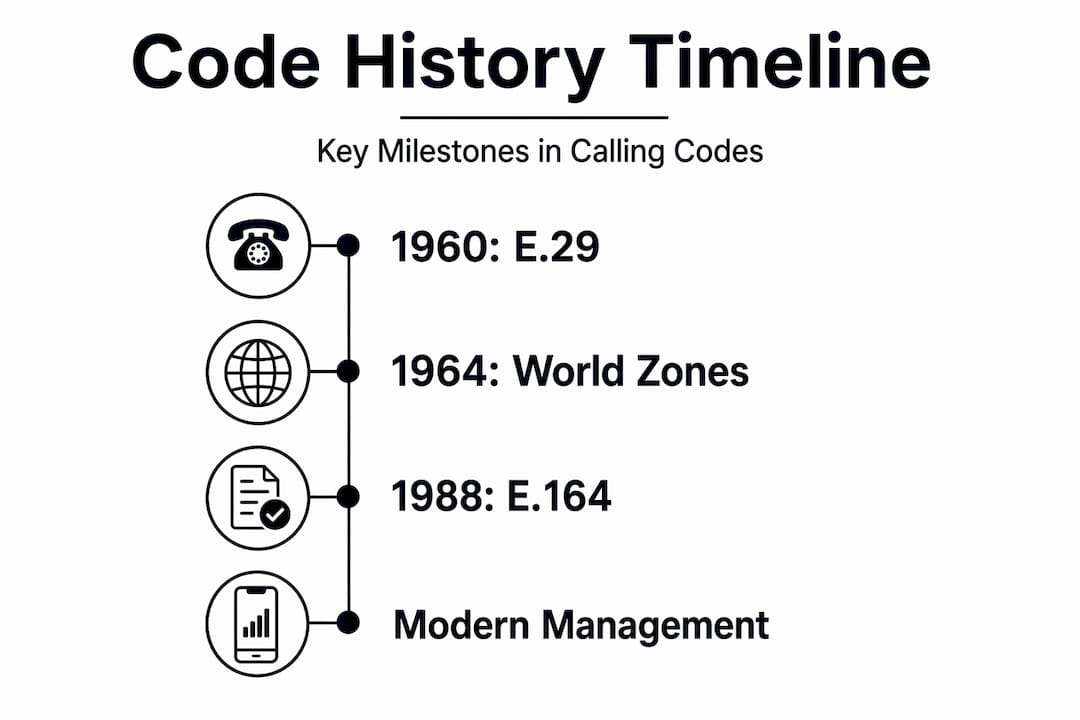
Country codes were first defined in 1960 by the Consultative Committee for International Telegraphy and Telephony, known as CCITT. Its Recommendation E.29 established an international numbering plan initially covering Europe and parts of western Asia and Mediterranean countries. CCITT was the predecessor body to what is now the ITU Telecommunication Standardization Sector, or ITU-T, and its role was to coordinate technical standards across national telephone administrations.
The early codes under E.29 were not designed to cover the entire globe. They reflected the telecommunications infrastructure that existed at the time. European networks were the most interconnected, so the initial plan prioritized those connections.
Key characteristics of the E.29 era included:
- Codes were short where network capacity was highest, typically one or two digits for major European nations.
- The plan used a zone-based structure, grouping countries by geography and existing routing relationships.
- Coverage was limited to Europe, parts of western Asia, and Mediterranean countries, leaving large portions of the world without standardized codes.
- The system was designed to fit within the switching technology of the early 1960s, which constrained total digit counts.
Pro Tip: When studying early calling code history, look at the original E.29 document alongside a 1960s telephone routing map. The codes follow the physical cable and microwave relay routes of the era, not just political borders.
This initial framework was a practical engineering solution, not a geopolitical statement. However, the decisions made in 1960 set precedents that would carry significant political weight as the plan expanded globally.
World numbering zones and global expansion
The calling code timeline took a major step forward in 1964. E.29 was expanded with global world numbering zones, extending the plan beyond Europe to cover the entire planet. The world was divided into nine geographic zones, each assigned a leading digit from 1 to 9. This structure gave every country on Earth a place within the international numbering plan.
The zone assignments followed a broad geographic logic, though political and economic factors influenced specific allocations within each zone.
| Zone | Region | Example codes |
|---|---|---|
| Zone 1 | North America (NANP) | +1 (US, Canada, Caribbean) |
| Zone 2 | Africa | +20 (Egypt), +27 (South Africa) |
| Zone 3 and 4 | Europe | +33 (France), +44 (UK), +49 (Germany) |
| Zone 5 | South and Central America | +55 (Brazil), +52 (Mexico) |
| Zone 6 | Southeast Asia and Oceania | +61 (Australia), +64 (New Zealand) |
| Zone 7 | Russia and Kazakhstan | +7 |
| Zone 8 | East Asia | +81 (Japan), +86 (China) |
| Zone 9 | South and West Asia | +91 (India), +92 (Pakistan) |
Zone 1 corresponds to the North American Numbering Plan, which uses a single country code +1 shared across the United States, Canada, and many Caribbean nations. This was possible because North American telephone networks were already deeply integrated before 1964, functioning as a single administrative region for routing purposes.
"The digits in a country code reflect a history of international coordination more than pure geography. Zone assignments in 1964 were as much about existing routing infrastructure as about where countries sat on a map."
The two-digit codes assigned to Europe under zones 3 and 4 reflected the high density of nations in that region. Fitting dozens of countries into a single zone required two-digit codes to create enough unique combinations. Zones 1 and 7, covering vast but less densely divided regions, could use single-digit codes.
The ITU-T E.164 standard and modern formalization
The evolution of calling codes reached a defining moment with the introduction of ITU-T Recommendation E.164, which appeared officially in 1988. This was the ISDN era, when digital telephone networks were replacing analog switching systems, and the old E.29 framework needed a formal update to match the new technical realities.
E.164 did not replace the zone structure. It formalized and expanded it, adding precise rules about number length, format, and hierarchy. Understanding E.164 is central to any study of country calling code history because it defines the framework that carriers, developers, and regulators still use today.
The key elements E.164 introduced are:
- Maximum number length. E.164 limits telephone numbers to 15 digits, including the country code. This cap was set to accommodate the routing tables used in digital switching equipment.
- Country code length. Country codes range from one to three digits. Shorter codes were assigned to regions with higher call volumes or greater political influence during the allocation process.
- Hierarchical structure. E.164 defines a public numbering taxonomy that breaks a full international number into three parts: the country code (CC), the national destination code (NDC), and the subscriber number (SN).
- Scope expansion. E.164 accommodates categories beyond geographic areas, including global services (such as +800 for international freephone), networks, and groups of countries.
- The plus prefix. The leading plus sign (+) signals that the digits following it are an E.164 number beginning with a country code. This replaced country-specific international exit codes as the universal notation.
Pro Tip: When reading any international phone number in E.164 format, mentally split it into CC + NDC + SN. This three-part structure explains why some numbers look longer in certain countries. India's +91 uses a two-digit country code, leaving 13 digits for the national portion.
The assignment of country codes requires balancing engineering constraints and political influences, and changes are often implemented years after official approval. The gap between ITU decision, publication, and actual field deployment has historically been significant, sometimes stretching across multiple years as carriers update their routing databases.

Geopolitical examples in code assignments
Some of the most instructive history of country calling codes examples come from cases where politics and engineering collided. The allocation process was never purely technical.
Historical code assignments were influenced by telecommunications capacity and geopolitics, with dominant countries like France, the UK, the US, and the USSR securing preferential numbers. Shorter codes mean fewer digits to dial, which in the era of manual operator-assisted calls translated directly into faster, cheaper connections. Getting a one-digit or short two-digit code was a practical advantage.
The North American Numbering Plan is the clearest example of scale driving a shared code. The US, Canada, and 23 other countries and territories all share +1. This was not a political compromise. It reflected the reality that North American telephone networks were built as a unified system before international codes existed.
| Scenario | Code | Notes |
|---|---|---|
| US and Canada share a code | +1 | Unified NANP network predates 1964 zone plan |
| UK gets a short European code | +44 | Reflects high call volume and political standing |
| Taiwan's unofficial status | +886 | Excluded from official ITU listings due to political recognition disputes |
| Russia retains Soviet-era code | +7 | Originally assigned to the USSR; retained after 1991 dissolution |
The Taiwan case is particularly instructive. China was able to have code 886 assigned to Taiwan without official ITU recognition of Taiwan as an independent state. This reflects how the ITU's membership structure, which recognizes governments rather than territories, directly shapes what appears in the official numbering plan. Taiwan uses +886 in practice, but its status in official ITU documentation remains a product of political reality rather than technical necessity.
The Soviet Union's +7 presents a different lesson. When the USSR dissolved in 1991, most former Soviet republics eventually received their own country codes. Russia retained +7, and Kazakhstan also continues to use +7, a legacy of the shared Soviet telecommunications infrastructure that was too deeply embedded to reassign quickly.
How country codes are assigned and managed today
The ITU-T remains the governing body for country code assignments. ITU-T Recommendation E.190 (2025) defines the current principles and responsibilities for numbering resource management, including the assignment and reclamation of E.164 country codes.
The current process involves several defined criteria and steps:
- Assignment requests are submitted by member states or recognized operating agencies to the ITU-T Director of the Telecommunication Standardization Bureau (TSB).
- Evaluation criteria include the applicant's technical readiness, the numbering capacity already available under existing codes, and the impact on global routing tables.
- Reclamation applies when a code is no longer in active use or when a territory's status changes. The ITU-T can reclaim and reassign unused codes.
- Reservation allows codes to be held for anticipated needs, such as new international services or emerging territories, without immediate assignment.
- Trial codes can be issued for testing new services before permanent allocation, reducing the risk of routing conflicts in live networks.
The ITU-T study groups that oversee numbering resources must also consider future scalability. The 15-digit limit in E.164 is not infinite. As mobile networks, IoT devices, and global services consume more number ranges, the management of numbering resources becomes a forward-looking engineering challenge, not just an administrative one.
My perspective on what this history actually teaches
I've spent considerable time studying how technical standards develop, and the history of country calling codes stands out as one of the clearest examples of how engineering decisions and political realities become permanently encoded into infrastructure.
What strikes me most is how the 1960 and 1964 decisions still shape what you dial today. The US has +1 not because of any grand design, but because North American networks were already unified when the zones were drawn. The UK has +44 because it had the political standing and call volume to claim a short European code. These were pragmatic decisions made by engineers and diplomats in rooms that most people have never heard of, and yet their outputs are used billions of times daily.
For telecommunications students, the lesson I find most underappreciated is this: numbering plans are not neutral. Every digit reflects a negotiation between what was technically possible and what was politically acceptable at a specific moment in time. Understanding that mix makes you a better engineer and a more informed analyst.
The other lesson is about international cooperation. The ITU-T framework, for all its bureaucratic complexity, produced a system that actually works across every country on Earth. That is not a given. It required sustained coordination across competing national interests for over six decades. The calling code timeline from 1960 to today is, in that sense, a record of what international technical cooperation can achieve when the incentives align.
— Kaj
Explore country codes with Countrycalling
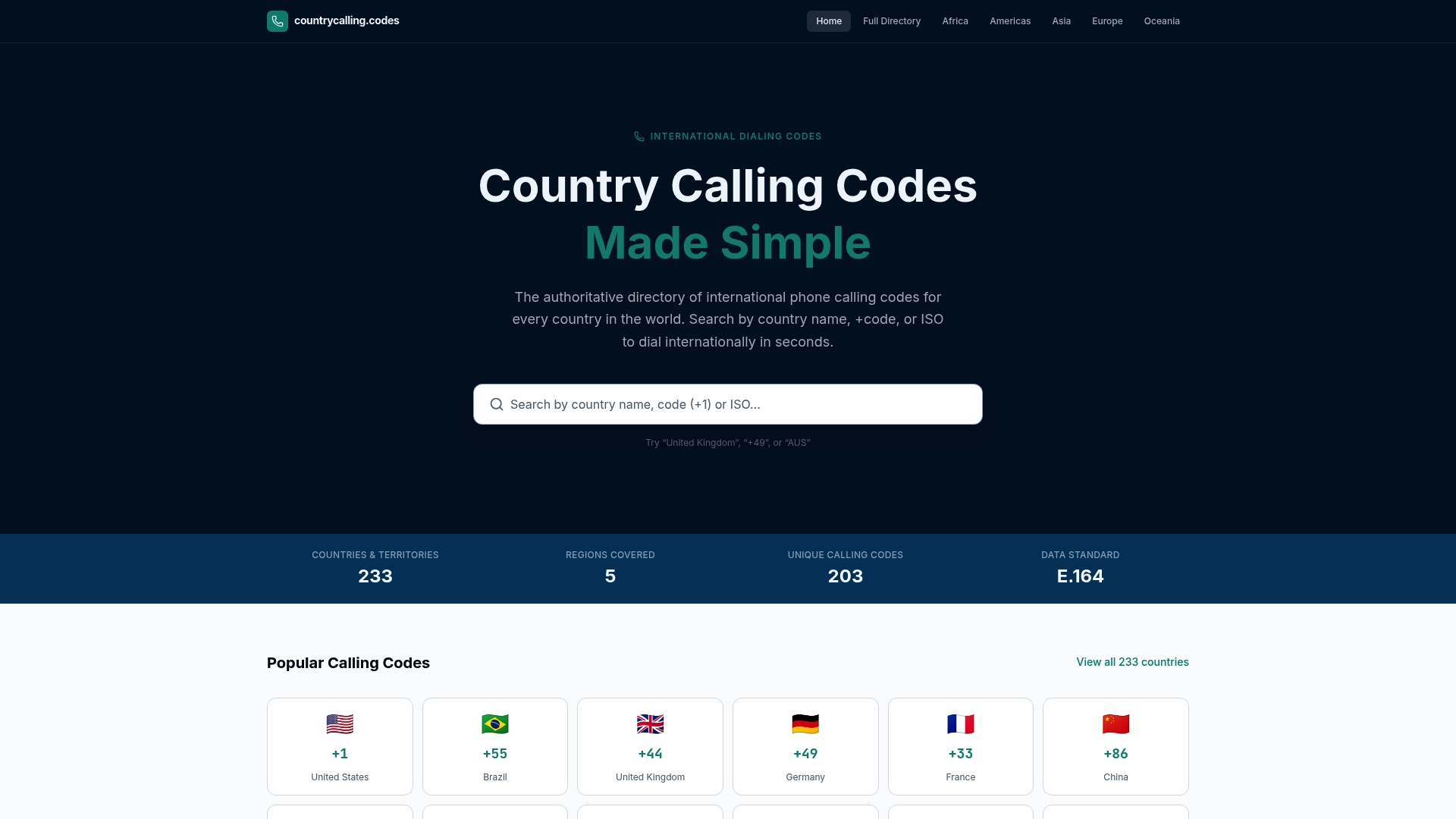
Countrycalling provides a detailed directory of international dialing codes built for researchers, students, and frequent international callers. Every country page includes the country code, trunk prefix, area codes, and practical dialing tips, all in one place without page reloads. Whether you are tracing the evolution of calling codes for academic research or simply need to confirm the correct prefix before an international call, the complete country codes directory gives you accurate, structured data instantly. Visit Countrycalling to search by country name or ISO code and get the information you need in seconds.
FAQ
When were country calling codes first created?
Country codes were first defined in 1960 by CCITT Recommendation E.29, covering Europe and parts of western Asia. The plan expanded to global world numbering zones in 1964.
What is ITU-T E.164 and why does it matter?
E.164 is the ITU-T standard that governs international telephone numbering, published officially in 1988. It sets the 15-digit maximum length, defines country code structure, and establishes the hierarchical format used by every carrier worldwide.
Why do the US and Canada share the same country code?
The US and Canada share +1 because the North American Numbering Plan unified their telephone networks before the 1964 global zone assignments were made. The shared code reflects integrated infrastructure, not a political decision.
Who decides which country gets which calling code?
The ITU-T manages country code assignments under Recommendation E.190, which defines the criteria for assignment, reclamation, and reservation of codes. Member states submit requests to the ITU-T Telecommunication Standardization Bureau.
How do geopolitics affect country code assignments?
Political influence shaped early allocations significantly, with dominant nations securing shorter codes. Cases like Taiwan's +886 and Russia retaining the Soviet-era +7 show how political realities continue to influence the numbering plan decades after the original decisions were made.