

Phone numbers look different everywhere you go. A number in Germany starts with a zero. A US number has three distinct segments. A UK mobile drops that leading zero the moment you dial internationally. Understanding how phone numbers are structured globally is not just useful trivia. It directly affects whether your call connects, whether your app stores data correctly, and whether a business can reach customers across borders without errors.
Table of Contents
- Key takeaways
- How phone numbers are structured globally: the E.164 standard
- National numbering plans: how countries organize their numbers
- Formatting and dialing phone numbers internationally
- International dialing prefixes and country code assignments
- My take on the biggest mistakes people make with phone numbers
- Find any country code instantly with Countrycalling
- FAQ
Key takeaways
| Point | Details |
|---|---|
| E.164 is the global standard | The ITU-T E.164 recommendation defines the international framework all phone numbers follow. |
| Country codes are 1 to 3 digits | Every country has a unique code assigned by the ITU, which prefixes all international numbers. |
| Trunk prefixes must be removed | Leading zeros used for domestic dialing are dropped when formatting a number for international use. |
| The plus sign is a placeholder | The "+" in a number means "replace this with your local international dialing prefix." |
| Software needs canonical format | Storing numbers in E.164 format prevents integration failures in telephony apps and databases. |
How phone numbers are structured globally: the E.164 standard
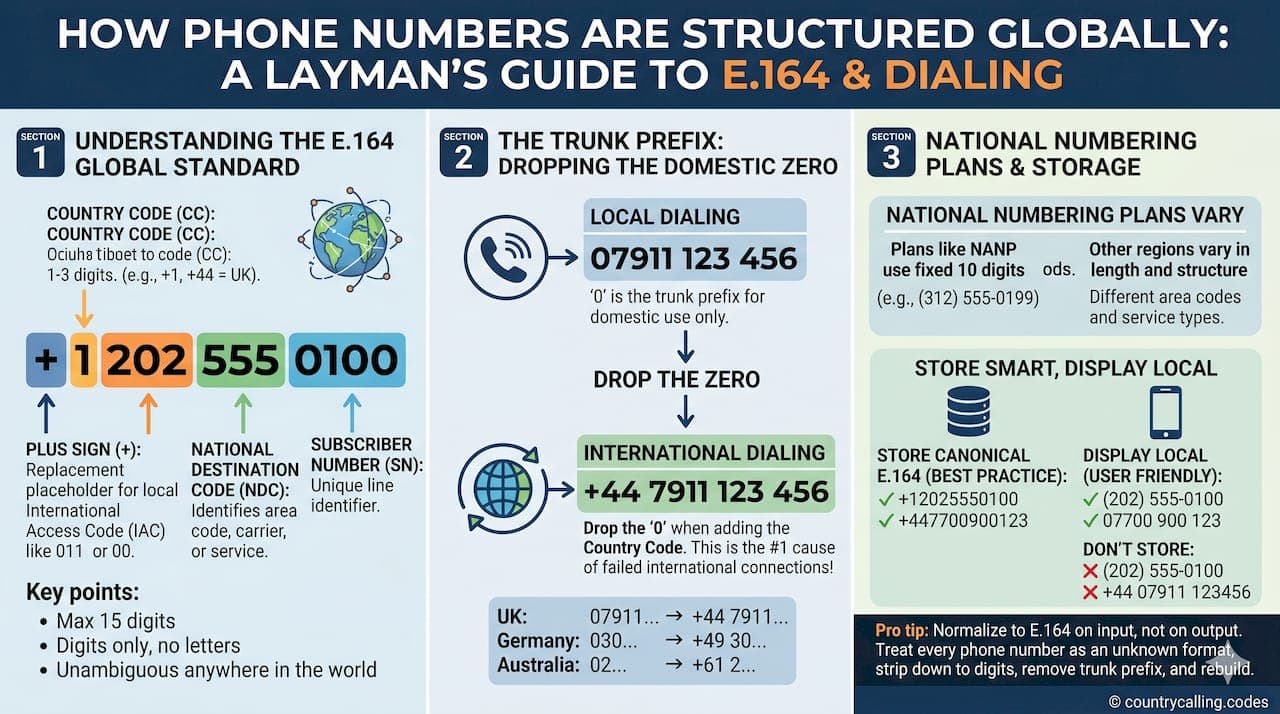
The ITU-T (International Telecommunication Union Telecommunication Standardization Sector) publishes a recommendation called E.164, and it is the closest thing the world has to a universal phone number rulebook. Every internationally dialable number fits inside this framework.
Here is what E.164 defines:
- Maximum length: A phone number may contain no more than 15 digits, digits only, no letters or symbols.
- Country code (CC): 1 to 3 digits identifying the country or territory.
- National destination code (NDC): Identifies the region, carrier, or service type within the country.
- Subscriber number (SN): The unique number assigned to the individual line. The NDC and SN together form the subscriber number, which can be up to 12 digits.
- Plus sign prefix: The internationally recognized representation starts with a "+" before the country code.
So a fully formatted E.164 number looks like this: +[CC][NDC][SN]. For example, a US number appears as +1 202 555 0100, where 1 is the country code, 202 is the area code (NDC), and 555 0100 is the subscriber number.
What makes E.164 powerful is that it separates international representation from local dialing procedures. A number stored in E.164 format is unambiguous anywhere in the world. There is no confusion about which country it belongs to, no guessing about whether a leading zero is part of the number or a dialing artifact.
"E.164 is a framework, not a country-specific plan. Valid number parsing often requires access to individual national numbering rules alongside the global standard."
Pro Tip: When saving phone numbers in any system, always store them in E.164 format first. Add local display formatting only when presenting numbers to users.
National numbering plans: how countries organize their numbers
E.164 sets the outer boundaries. Inside those boundaries, each country runs its own national numbering plan that defines exactly how numbers are organized domestically.
The North American Numbering Plan (NANP)
The NANP is one of the most widely recognized examples of a structured national plan. It covers the United States, Canada, and more than 20 Caribbean territories, all sharing country code 1.
The NANP uses a fixed 10-digit format broken into three parts:
- Area code (NPA): 3 digits identifying the geographic region or service.
- Central office code (NXX): 3 digits identifying the local exchange or carrier.
- Station number: 4 digits identifying the individual line.
A number like (312) 555-0199 means area code 312 (Chicago), exchange 555, station 0199. In E.164 format, that becomes +13125550199.
How other regions structure their numbers

Not every country uses a fixed-length plan like the NANP. Phone number structure by country varies considerably:
| Country | Country Code | Example Local Number | E.164 Format |
|---|---|---|---|
| United States | +1 | (202) 555-0100 | +12025550100 |
| United Kingdom | +44 | 07911 123456 | +447911123456 |
| Germany | +49 | 030 12345678 | +493012345678 |
| Australia | +61 | 02 9876 5432 | +61298765432 |
| Brazil | +55 | (11) 91234-5678 | +5511912345678 |
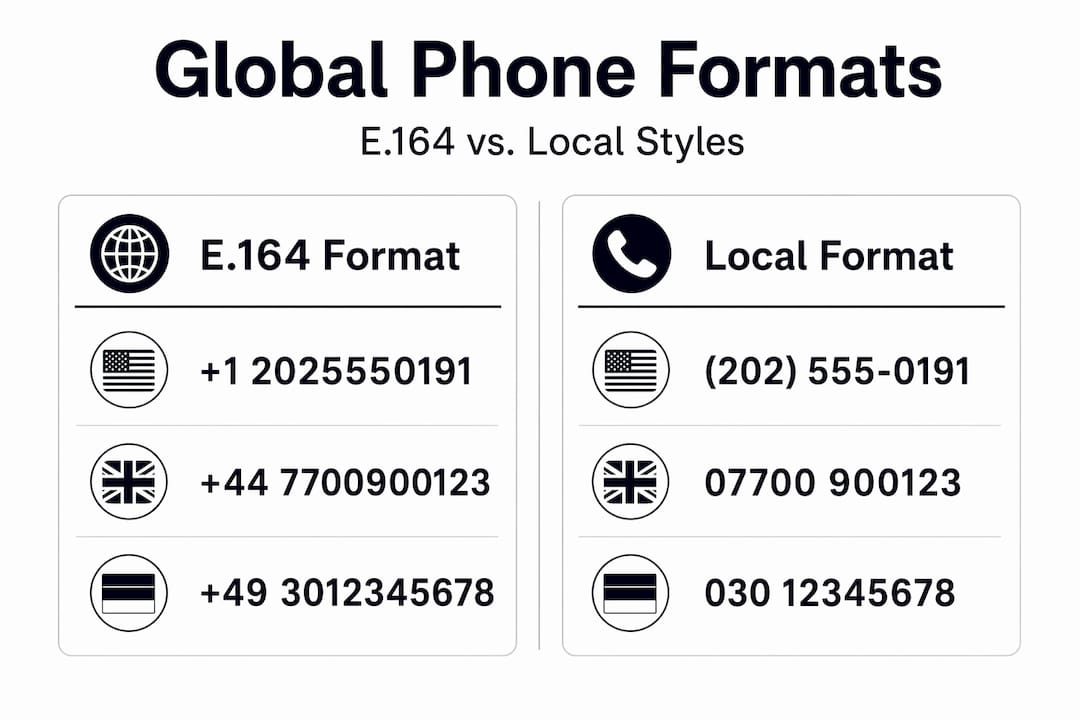
Notice that the UK number starts with a 0 locally but drops the leading zero when written in E.164. That leading 0 is a trunk prefix. It signals to the national network that you are dialing a domestic number, but it has no meaning internationally.
Pro Tip: If you are building a contact database for international use, always verify whether the number you received includes a trunk prefix. Strip it before storing the number in E.164 format.
Germany is another common example. A Berlin landline might be written locally as 030 12345678. The 0 is the trunk prefix. The 30 is the area code for Berlin. In E.164, the number becomes +493012345678. The 0 disappears entirely.
Formatting and dialing phone numbers internationally
Knowing the structure is one thing. Applying it correctly when dialing or storing numbers is where most errors occur. Here is how to handle phone numbers for international use.
Converting a local number to E.164
Follow these steps when converting any national number to international format:
- Identify the trunk prefix (usually a leading 0, but sometimes 1 in North America for long-distance).
- Remove the trunk prefix entirely.
- Add the country code directly after the plus sign.
- Write all remaining digits without spaces, dashes, or parentheses for storage purposes.
For example, the UK number 07700 900123 becomes +447700900123. The 0 is removed, +44 replaces it, and the rest of the digits follow without punctuation.
The plus sign and what it actually means
The plus sign (+) in a phone number is not a literal character you dial on a landline. It acts as a placeholder that tells the network "replace this with whatever international dialing prefix applies in your country." In the NANP region, that prefix is 011. In most of Europe, it is 00. So +447700900123 becomes 011447700900123 when dialed from the US, and 00447700900123 when dialed from Germany.
Storing numbers in software systems
Many systems require phone numbers stored as continuous digit strings with the plus sign and no spaces or punctuation. This is the canonical E.164 format. Storing +447700900123 rather than 07700 900123 or (0770) 090-0123 prevents integration failures across telephony APIs, CRMs, and messaging platforms.
Software systems often break integrations when numbers are not in this canonical form. A number with a stray space or a retained trunk prefix can fail to route correctly or trigger validation errors in automated systems.
Common pitfalls to avoid:
- Storing numbers with spaces, parentheses, or dashes in a database field meant for E.164.
- Keeping the trunk prefix (like a leading 0) when saving an international number.
- Omitting the country code entirely and assuming the system will infer it.
- Using local formatting (like (202) 555-0100) as the stored value rather than as a display format.
International dialing prefixes and country code assignments
Country codes are assigned by the ITU under the E.164 and E.123 recommendations. They range from 1 to 3 digits and are allocated based on region and size. The US and Canada share the single-digit code 1 under the NANP. Most European countries have 2-digit codes (like +44 for the UK and +49 for Germany). Many smaller nations in Africa, Asia, and the Pacific use 3-digit codes.
How international dialing prefixes work by region
Before you can reach the country code, you need to exit your own national network. That requires an international dialing prefix, also called an international access code or exit code. Within the NANP, the access code is 011. In most of Europe, it is 00. Some countries use other codes entirely.
Here is a comparison of international dialing prefixes across regions:
| Region / Country | International Dialing Prefix | Example Dialing UK (+44) |
|---|---|---|
| United States / Canada (NANP) | 011 | 011 44 7700 900123 |
| Most of Europe | 00 | 00 44 7700 900123 |
| Australia | 0011 | 0011 44 7700 900123 |
| Japan | 010 | 010 44 7700 900123 |
| Brazil | 00 + carrier code | 00 21 44 7700 900123 |
Key facts about country code assignment:
- Single-digit codes (like +1 and +7) were assigned to large regions or powerful early telecommunications nations.
- Two-digit codes cover most of Europe and larger nations globally.
- Three-digit codes are common in Africa, the Caribbean, and smaller Pacific nations.
- The ITU manages code assignments to maintain global uniqueness across all numbering plans.
Understanding phone number systems at this level explains why you cannot simply dial a number as written on a local business card when calling from abroad. The trunk prefix must go, the country code must be added, and the correct exit code for your country must come first.
My take on the biggest mistakes people make with phone numbers
I have spent years working with international telecommunications data, and the single most common error I see is the trunk prefix problem. People copy a phone number exactly as it appears on a local website, paste it into an international dialing field, and wonder why the call fails. The leading 0 is the culprit almost every time.
What surprises me more is how often this same mistake appears in software. Developers build contact management systems, collect phone numbers from users in dozens of countries, and store whatever format the user typed. Six months later, an SMS campaign fails because half the numbers have retained trunk prefixes or missing country codes. The fix is always the same: normalize to E.164 on input, not on output.
The other thing I find underappreciated is that E.164 is a framework, not a complete rulebook. Knowing a number starts with +61 tells you it is Australian. But validating whether it is a real, currently active Australian mobile number requires knowledge of Australia's national numbering plan, which the ITU does not maintain for you. This is why phone number validation libraries exist and why they need regular updates as national plans evolve.
My practical advice: treat every phone number as an unknown format on arrival. Strip it down to digits, identify the country code, remove the trunk prefix, and rebuild it in E.164. That process works for every country, every time.
— Kaj
Find any country code instantly with Countrycalling
Getting international dialing right starts with having accurate country code data at hand. Countrycalling provides a complete international directory covering every country and territory, including country calling codes, trunk prefixes, area codes, and specific dialing tips.
Whether you are a traveler preparing to call abroad, a developer building a phone validation feature, or a business managing contacts across multiple countries, Countrycalling gives you the precise data you need without digging through outdated references. The directory is searchable by country name or ISO code, with results that load instantly. Each country page includes the full dialing sequence from major originating countries, so you know exactly what to dial from start to finish. Visit Countrycalling to look up any country code and get the dialing details right the first time.
FAQ
What is the E.164 phone number format?
E.164 is the ITU-T international standard for phone numbers. It specifies a maximum of 15 digits, starting with a country code of 1 to 3 digits, followed by the subscriber number, and represented with a leading plus sign.
Why do I remove the leading zero when dialing internationally?
The leading zero is a trunk prefix used for domestic dialing within a country. It has no meaning outside that country's network, so it must be removed and replaced with the country code when formatting a number for international use.
What does the plus sign mean in a phone number?
The plus sign (+) is a placeholder for your local international dialing prefix. In the US, it represents 011. In most of Europe, it represents 00. The actual digits you dial depend on which country you are calling from.
How are country calling codes assigned?
The ITU assigns country codes under the E.164 recommendation. Codes range from 1 to 3 digits. Larger regions and historically significant telecommunications nations received shorter codes, while smaller nations typically have 3-digit codes.
How should phone numbers be stored in software?
Phone numbers should be stored in canonical E.164 format: a plus sign followed by the country code and subscriber number, with no spaces, dashes, or parentheses. Local display formatting should only be applied when presenting numbers to users.