
TL;DR:
- International dialing involves sequential use of an exit code, a country code, and a national number to ensure accurate international calls. Using the E.164 format with a '+' sign standardizes numbers globally, while dropping domestic trunk prefixes like '0' prevents routing errors. Proper understanding of these code types, validated through resources like Countrycalling, reduces failed calls and enhances telephony reliability worldwide.
Understanding the different international dialing code types is the first step toward making reliable calls across borders. Whether you're a frequent traveler, a business professional managing global contacts, or a developer building a telephony system, knowing how these codes work prevents failed calls and costly errors. This guide breaks down every major code type, explains how they interact, and gives you the practical knowledge to dial correctly from anywhere in the world.
Table of Contents
- Key takeaways
- Understanding international dialing code types
- 1. International access codes (exit codes)
- 2. Country calling codes
- 3. National destination codes (area and city codes)
- 4. Trunk prefixes
- 5. Subscriber numbers
- 6. Special service codes and non-geographic codes
- 7. VoIP and virtual number prefixes
- 8. Comparison of dialing code types
- 9. Practical recommendations for correct dialing
- My perspective on international dialing code confusion
- Find any dialing code instantly with Countrycalling
- FAQ
Key takeaways
| Point | Details |
|---|---|
| Three core code types | Every international call uses an exit code, a country code, and a national number in that order. |
| E.164 is the standard | Storing numbers in E.164 format with a leading '+' prevents routing failures across systems. |
| Trunk prefixes get dropped | The domestic leading digit (often '0') is omitted when dialing internationally. |
| Country codes vary in length | ITU-assigned country codes range from 1 to 3 digits depending on the region. |
| Exit codes differ by country | The US uses 011, most of Europe uses 00, and the '+' notation covers both universally. |
Understanding international dialing code types
International telephone dialing codes are ITU-defined numeric prefixes that allow callers to reach subscribers in other countries through the global public switched telephone network. They are not random. Each segment of a full international number serves a specific function, and confusing one type with another is the most common reason calls fail.
The three core components of any international call are:
- International access prefix (exit code): The digits you dial first to signal your local network that you're placing an international call. This varies by country of origin.
- Country calling code: The destination-specific numeric prefix assigned by the ITU that identifies the target country or territory.
- National destination/subscriber number: The local number within the destination country, which may itself include an area code or city code.
Mixing these code types improperly causes call routing failures. The full dialed sequence must follow the correct order: exit code + country code + national number.
One critical formatting concept is the leading '+' sign. Under the ITU-T E.164 standard, the '+' is a universal notation that tells any network to substitute the caller's local international access prefix automatically. It separates presentation from dialing logic. A number displayed as +1 202 555 0100 is formatted for human reading. The actual dialed string depends on where you're calling from.
A common misconception worth addressing: ISO country codes (like "US" for the United States or "DE" for Germany) are alphabetic identifiers used in data systems. They have no direct relationship to numeric dialing codes. Confusing the two leads to errors in databases and contact management systems.
Pro Tip: Store all international numbers in E.164 canonical form (e.g., +14155552671) in any database or CRM. This format is location-neutral and eliminates ambiguity caused by local trunk prefixes or regional formatting habits.
1. International access codes (exit codes)
The international access code, also called the exit code or international dialing prefix, is the sequence you dial before the country code to tell your local network you want to place an international call.
Common exit codes by region:
- 011: Used in the United States, Canada, and most of the North American Numbering Plan (NANP) countries.
- 00: The most widely used exit code globally, covering most of Europe, Asia, Africa, and Latin America.
- 0011: Used in Australia.
- 010: Used in Japan for some carriers.
The '+' notation replaces the exit code in stored numbers and display formats. When you dial +44 20 7946 0958 from the US, your phone automatically converts the '+' to 011. From Germany, it converts to 00. This is why the '+' sign prevents ambiguity and allows numbers to be stored in a universal format regardless of caller location.
2. Country calling codes

Country calling codes are destination-specific numeric prefixes assigned by the International Telecommunication Union (ITU). Every country or territory that participates in the global telephone network has at least one. These codes come directly after the exit code in a dialed sequence.
Country codes range from 1 to 3 digits depending on the ITU zone. The ITU divides the world into numbered zones:
- Zone 1: North America and the Caribbean. All NANP countries share country code +1.
- Zone 2: Africa. Country codes begin with 2 (e.g., +27 for South Africa, +234 for Nigeria).
- Zone 3 and 4: Europe. Codes begin with 3 or 4 (e.g., +44 for the UK, +49 for Germany, +33 for France).
- Zone 5: South and Central America (e.g., +55 for Brazil, +52 for Mexico).
- Zone 6: Oceania (e.g., +61 for Australia, +64 for New Zealand).
- Zone 7: Russia and Kazakhstan, both using +7.
- Zone 8 and 9: Asia and the Middle East (e.g., +81 for Japan, +86 for China, +91 for India).
Single-digit country codes like +1 and +7 cover large geographic regions or populations. Three-digit codes are typically assigned to smaller nations or territories. You can look up any country's code in the complete international directory maintained by Countrycalling.
3. National destination codes (area and city codes)
Once the country code routes your call to the right country, the national destination code (NDC) routes it to the right region, city, or network within that country. NDCs are the area codes or city codes that most people recognize from domestic dialing.
Examples include:
- 020 for London within the UK (though the leading '0' is dropped internationally, making it 44 20).
- 212 for New York City within the US.
- 030 for Berlin within Germany (dialed as 49 30 internationally).
NDCs vary significantly in length. In some countries they are 2 digits; in others they can be 4 or 5 digits. The length often depends on how many subscribers a region has and how the national numbering plan is structured.
Pro Tip: When dialing internationally, always drop the leading '0' from the national destination code. In the UK, the local number 020 7946 0958 becomes +44 20 7946 0958 internationally. Keeping the '0' is one of the most common dialing mistakes.
4. Trunk prefixes
The trunk prefix is a digit (most commonly '0') that callers dial within a country to access the long-distance or national network. It signals the switch to route the call through the national network rather than the local exchange.
Trunk prefixes are strictly domestic. The domestic trunk prefix is omitted in international dialing under E.164 format to avoid misrouting and validation failures. Keeping it in an internationally formatted number causes the call to fail or reach the wrong number.
Countries with a trunk prefix of '0' include the UK, France, Germany, Italy, Australia, and many others. The US and Canada do not use a trunk prefix for long-distance calls within the NANP. Russia uses '8' as its trunk prefix for some call types.
5. Subscriber numbers
The subscriber number is the final segment of a full international number. It identifies the specific line, device, or account within the local exchange. Combined with the NDC, it forms the national (significant) number.
Under E.164, the total number length including country code must not exceed 15 digits. The national number portion can be up to 12 digits. In practice, most subscriber numbers are 6 to 8 digits long, but this varies by country.
Subscriber numbers themselves do not change based on how you dial internationally. They remain fixed. The only adjustments happen in the prefix layers above them.
6. Special service codes and non-geographic codes
Not all international phone prefixes follow the standard country code model. Several special code types exist for specific purposes:
- +800 (UIFN): Universal International Freephone Numbers. These are toll-free numbers accessible from multiple countries under a single number. Assigned by the ITU.
- +870: Previously used for Inmarsat satellite services. Now reassigned.
- +881 and +882: Global Mobile Satellite System (GMSS) codes used for satellite phone services operating outside national borders.
- +979 and +991: Premium rate international numbers used for paid services.
These codes are part of the types of country codes that fall outside standard geographic assignment. They are less commonly encountered but matter for businesses operating satellite communications or international toll-free lines.
7. VoIP and virtual number prefixes
VoIP services and virtual number providers sometimes assign numbers with country codes that do not correspond to a physical location. A US business might have a UK number (+44) to appear local to British customers, even though calls route over the internet to a US office.
These numbers follow the same E.164 structure as geographic numbers. The country code still indicates the number's registered territory, not the physical location of the recipient. This distinction matters for businesses setting up international presence and for developers validating phone numbers in contact systems.
Storing numbers in E.164 canonical form is especially important when handling virtual numbers, since the country code may not match the user's actual location or time zone.
8. Comparison of dialing code types
The table below summarizes the key attributes of each international dialing code type for quick reference.
| Code type | Purpose | Length | Varies by | Position in full number | Example |
|---|---|---|---|---|---|
| International exit code | Signals international call intent | 2-4 digits | Origin country | First | 011 (US), 00 (Europe) |
| Country calling code | Routes call to destination country | 1-3 digits | Destination country | After exit code | +1, +44, +49, +86 |
| National destination code | Routes to region or city | 1-5 digits | Destination country | After country code | 20 (London), 212 (NYC) |
| Trunk prefix | Accesses national long-distance network | 1 digit | Destination country | Domestic only, omit internationally | 0 (UK, Germany), 8 (Russia) |
| Subscriber number | Identifies specific line | 4-8 digits | Carrier/country | Last | 7946 0958 |
| Special/non-geographic code | Satellite, toll-free, premium services | 3 digits | ITU assignment | Replaces country code | +800, +882 |
The most common dialing error is retaining the trunk prefix when dialing internationally. The second most common is using the wrong exit code for the origin country. Both errors result in either a failed call or a wrong connection.
9. Practical recommendations for correct dialing
Knowing the types is only useful if you apply them correctly. Here are specific recommendations based on context.
For individuals dialing abroad:
- Always use the '+' notation when saving numbers to your phone. It works from any country without modification.
- Confirm the exit code for the country you are calling from if you are dialing manually without '+'.
- Drop the trunk prefix from the destination number before dialing.
For professionals managing contact databases:
- Format all numbers in E.164 canonical form: + followed by country code and national number, no spaces, no punctuation.
- Validate numbers at the point of entry using a phone number parsing library that recognizes country-specific formats.
- Do not store trunk prefixes in international numbers. They will cause routing failures in automated systems.
For travelers using mobile phones:
- Modern smartphones handle the '+' automatically when you press and hold the '0' key. Use this instead of dialing exit codes manually.
- Roaming does not change the format you need to dial. International numbers work the same way regardless of which country's SIM you are using.
Common dialing mistakes to avoid:
- Dialing the trunk prefix (e.g., 0) after the country code.
- Using the wrong exit code for your origin country.
- Confusing ISO alphabetic codes (US, DE, JP) with numeric dialing codes.
- Omitting the national destination code when calling a geographic number.
Pro Tip: Before dialing an unfamiliar country, verify both the country calling code and the correct exit code for your origin country. A quick lookup at countrycalling.codes takes seconds and prevents a failed call.
My perspective on international dialing code confusion
I've worked with telephony data long enough to know that most international dialing failures come from one specific misunderstanding: people treat the phone number as a single block of digits rather than a structured sequence of distinct code types. In my experience, even technically literate professionals make this mistake when they encounter an unfamiliar country's numbering format.
What I've found is that the E.164 standard resolves nearly every ambiguity, but only when it's applied consistently. The moment someone stores a number with a trunk prefix or a local exit code baked in, the entire system breaks. I've seen CRM databases with thousands of contact records that were effectively unusable for automated outbound calling because no one enforced E.164 at data entry.
The '+' sign is the single most underrated tool in international telephony. It looks simple, but it carries real technical weight. Telecom systems translate it dynamically into the appropriate local access prefix, which means a number stored correctly with '+' works from any device in any country without modification.
My honest assessment: the confusion around international dialing code types is not a user failure. It's a documentation failure. Most people are never told that exit codes, country codes, and trunk prefixes are separate things with separate rules. Once you understand the structure, the logic becomes clear and consistent across every country you'll ever need to call.
— Kaj
Find any dialing code instantly with Countrycalling
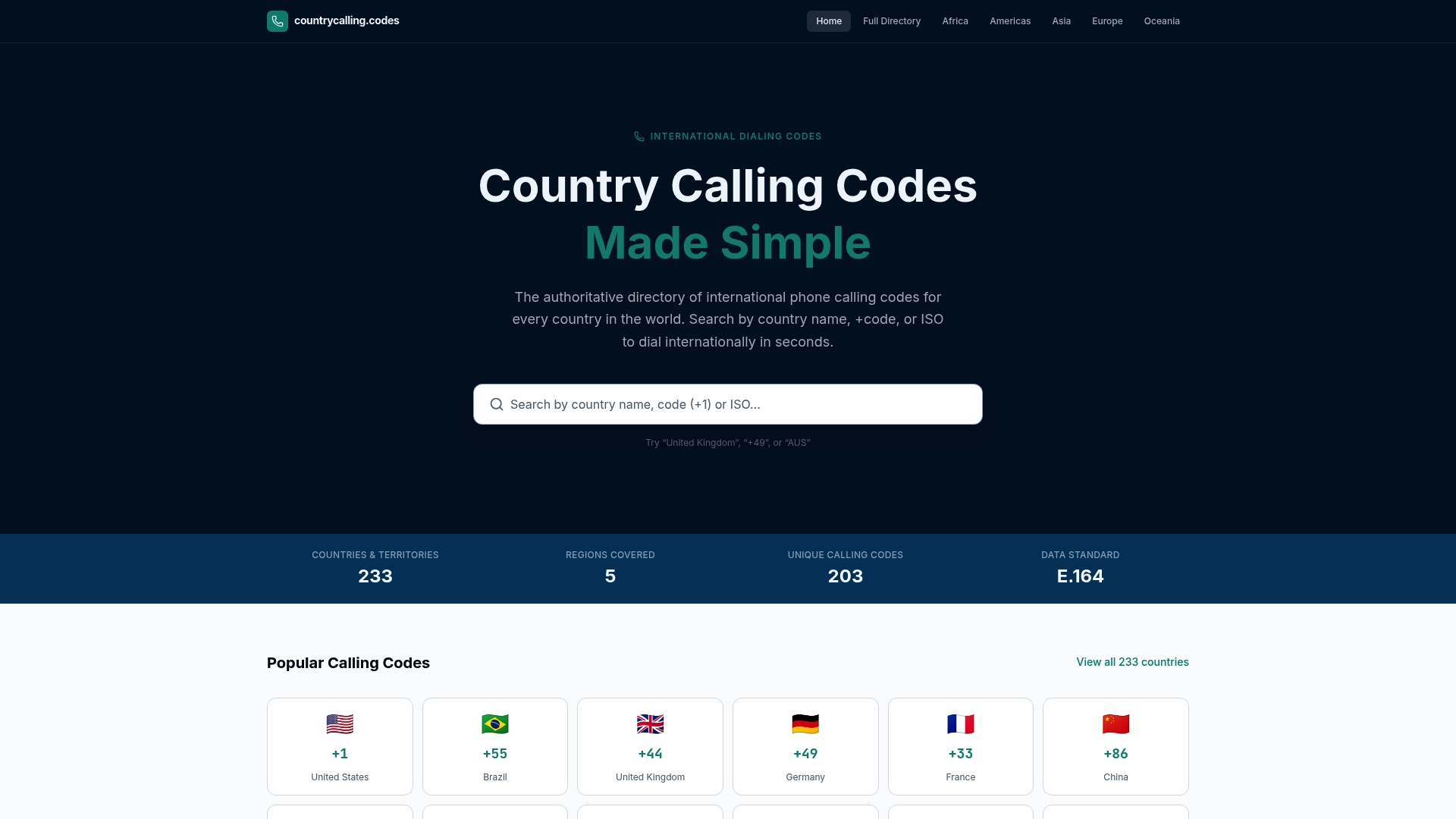
Countrycalling maintains a regularly updated directory covering every country's calling code, trunk prefix, area codes, and dialing tips in one place. Whether you need to verify a single country code or build a reference into a technical system, the complete calling codes directory gives you accurate data without page reloads or unnecessary steps. The site also includes detailed country pages with structured data useful for developers and clean lookup tools for travelers and business professionals. If you need reliable, up-to-date international dialing code information, Countrycalling is the resource built specifically for that purpose.
FAQ
What are the three main international dialing code types?
The three main types are the international access/exit code (origin-specific), the country calling code (destination-specific), and the national destination/subscriber number. Each serves a distinct function in routing an international call correctly.
What is the E.164 standard for phone numbers?
E.164 is the ITU standard defining international telephone number formats as up to 15 digits total, consisting of a 1 to 3 digit country code followed by the national number. Numbers in E.164 format begin with '+' to indicate the international prefix.
Why do I drop the '0' when dialing internationally?
The leading '0' is a domestic trunk prefix used only within the destination country's national network. Under E.164, it is omitted in international dialing to prevent misrouting. For example, the UK number 020 7946 0958 becomes +44 20 7946 0958 internationally.
How do I find the correct dialing code for any country?
Use a reliable directory like Countrycalling, which lists every country's calling code alongside trunk prefixes and area codes. You can also search by country name or ISO code for fast results.
Are country calling codes the same as ISO country codes?
No. ISO country codes are alphabetic identifiers (e.g., US, DE, JP) used in data systems and are unrelated to numeric dialing codes. Country calling codes are numeric prefixes assigned by the ITU specifically for telephone routing.